If you’ve ever stood in a grocery store’s tea aisle, staring at rows of tall, unlabeled tins or dense boxes of 20 identical tea bags, wondering where to start—let me introduce you to the sample tea box, the single most underrated tool for anyone who loves tea, or anyone trying to stock a small café, boutique, or even a gift shop with quality, approachable blends. As a tea samples supplier, I’ve spent the last six years curating these boxes, and I’ll be honest: most people I talk to still don’t get what a sample tea box actually is, and why it’s way more useful than that giant box of 100 generic black tea bags you can pick up for $5 at a big box store. Tea Samples
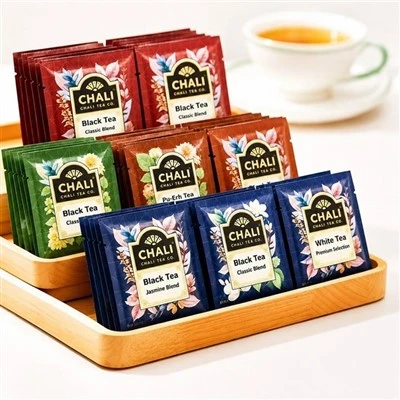
First, let’s cut through the confusion. A sample tea box isn’t just a random pile of tea bags stuffed into a box. It’s a curated set of small, single-serve portions—usually 2 to 5 grams each, sometimes a loose-leaf infuser pre-loaded, sometimes a sealed, fresh bag for single steeping—of teas you can’t easily find elsewhere, organized to fit a specific need. For the home drinker, that means it might be a mix of classics you know (like a smooth English breakfast) and teas you’ve never heard of (like a wild-harvested rooibos from a small farm in the Western Cape, or a jasmine green tea scented with fresh blossoms in spring). For small businesses? It’s a way to test which blends your regulars will actually buy, without shelling out for a 5-pound bulk bag of something no one likes.
Here’s the science part, because tea is an agricultural product, and freshness is everything. Any tea that’s left in a bulk bag for more than 3 months starts to lose its volatile oils—the compounds that give it flavor, aroma, and even those subtle health benefits people talk about. A sample box fixes that: every portion is packaged within 48 hours of being harvested or blended, so when you steep it, it tastes like it did on the farm, not like something that’s been sitting on a shelf for a year. I’ve had customers tell me that after trying my sample boxes, they can’t go back to grocery store tea, because there’s a noticeable difference in the brightness of the first sip, or the way the aroma lingers. That’s not hype—that’s just tea in its fresh, unprocessed form.
Let’s break down what goes into a typical sample tea box, so you can see why it’s not just a gimmick. First, the curation angle. You can’t throw 10 random teas into a box and call it a sample set. A good sample box has a theme. For example, we make a “Seasonal Transition” box every March, right when people are tired of heavy holiday black teas and ready for something lighter: it includes a white peach oolong from Taiwan, a mint green tea from a family farm in Zhejiang, a floral chamomile that’s organically grown, and a small portion of honeybush that’s caffeine-free for people who don’t drink after 3 p.m. Another popular one is the “Beginner’s Tea Exploration” box, which avoids super strong or bitter blends, and instead focuses on approachable flavors: vanilla black tea, honey ginger, and a berry hibiscus, all with notes that don’t overwhelm new tea drinkers.
For businesses, though, sample boxes serve a different purpose—they’re a low-risk way to test new inventory. When a café owner comes to me, they don’t want to order a $200 case of a new green tea only to find out their customers hate the grassy taste. A sample box for businesses (we call them “vendor test kits”) has 20 small portions of 20 different blends, including some popular classics and some lesser-known specialty teas. Last year, a small café in Portland used one of these kits and found that their regulars went crazy for a matcha latte blend we carry—they ended up ordering 5 pounds of it, which became their top-selling item for 6 months. That’s the kind of win sample boxes deliver: they let you test before you invest.
Now, let’s talk about the details that make a sample box work. It’s not just the tea—it’s the packaging. Every sample portion is sealed in airtight, light-proof sachets or small tins, because oxygen and light are the two biggest enemies of fresh tea. I’ve seen suppliers use plastic bags that let in light, and by the time the customer gets it, the tea is dull and stale. We use compostable sachets (no plastic, which is a big plus for eco-conscious drinkers) that block light and keep the tea fresh until you’re ready to steep. Also, every sample box comes with a little guide: it tells you where the tea came from, how to steep it (water temperature, steeping time), and a little note about the farm or the farmer who grew it. That’s a big part of the experience—tea isn’t just a beverage, it’s connected to people, and that guide helps you feel that connection, even when you’re just trying a small sample.
Wait, but what about people who say “I can just buy a single tea bag from a store”? Sure, but a single store-bought tea bag is usually a blend that’s been sitting on a shelf for months, and it’s often a mass-produced product from a big brand, not something that’s unique. A sample tea box gives you variety, but it also gives you access to small-batch, specialty teas that you won’t find at your local grocery store. For example, I work with a small family farm in India that grows a Darjeeling tea that’s only available in 100-pound batches a year—you can’t buy a 1-pound bag of it, but you can try a 3-gram sample in our box. That’s the kind of thing that makes sample boxes valuable: they open up a world of tea you didn’t know existed.
I should also mention that sample boxes aren’t just for black teas. We have sample sets for herbal teas, green teas, oolongs, matcha, rooibos, even pu-erh (the aged fermented tea that’s big in Asian markets). A lot of people think tea is just black or green, but there are hundreds of types, each with their own flavor profile. Last month, a customer told me she’d only ever drunk black tea before, and after trying our oolong and white tea sample box, she started drinking a cup every morning instead of her usual coffee. That’s the impact a good sample box can have: it’s not just a set of samples, it’s a way to expand your palate.
Now, let’s talk about the common mistakes people make when choosing a sample tea box. First, don’t go for a box that’s too cheap—if it’s under $10 for 12 samples, the tea is probably mass-produced, stale, or full of additives. Good sample boxes cost $15 to $30, because they use fresh, specialty tea and high-quality packaging. Second, don’t pick a box without a theme— a random collection of 15 teas might be fun for a week, but a themed box helps you actually learn about tea (like a “Caffeine-Free Blends” box or “Traditional Teas of Japan” box). Third, if you’re a business, don’t ignore the business-specific sample kits. A lot of suppliers make home-focused boxes, but if you’re a café, boutique, or restaurant, you need samples that are portioned correctly for your needs, and that come with bulk pricing options if you decide to order.
As someone who’s been in the tea sample business for six years, I’ve seen how these boxes work for everyone: a college student on a budget can try 10 different teas for $20 without committing to a whole pound of something they don’t like. A retirement community can use sample boxes for their social events, letting residents pick their favorite teas for their common room. A boutique hotel can use sample boxes as a welcome amenity in guest rooms, giving guests a taste of local or specialty teas that they can’t get elsewhere. It’s not just a product—it’s a tool for discovery.
If you’re a home tea lover who’s tired of the same old black tea, or a small business owner looking to add new, high-quality blends to your selection, our sample tea boxes are designed for you. We offer both home-focused curated sets and bulk vendor test kits, all with fresh, small-batch teas sourced directly from family farms around the world. To learn more about our current sample options, discuss bulk pricing, or ask questions about specific blends, don’t hesitate to reach out to our team. We’re here to help you find the right tea, whether you’re just starting your tea journey or looking to refresh your business’s menu.
Wellness Functional Tea References:
- Food and Agriculture Organization of the United Nations. Tea Processing and Quality Preservation.
- International Tea Committee. Annual Bulletin of Statistics.
- Journal of Food Science and Technology. Sensory Evaluation of Specialty Teas.
- Tea Association of the USA. Consumer Tea Preference Trends.
- World Health Organization. Health Benefits of Tea Consumption.
Yuni Food Co., Ltd.
We’re known as one of the most experienced tea samples manufacturers in China, featured by quality products and good service. Please feel free to wholesale the best tea samples at competitive price from our factory. Welcome to contact us for more details.
Address: Building 88, No. 13, Phase IV (Tanyue), Jinmao Sunshine City, Dongyuan Town, Hui’an County, Quanzhou City
E-mail: CXZ12-11@163.com
WebSite: https://www.yunileaf.com/
