If you’ve ever worked in industrial die casting, you know mold sticking to parts is the kind of headache that kills production times, scrap rates, and even your bottom line. As someone who’s been supplying die casting molds for over a decade, I’ve seen this issue derail small shops and big manufacturers alike—usually because people treat it like a “one-size-fits-all” fix instead of something you can proactively prevent with the right steps. Let’s cut through the jargon and talk about what actually works, from a guy who’s built hundreds of molds for precision industrial parts. Industrial Parts Die Casting Mold
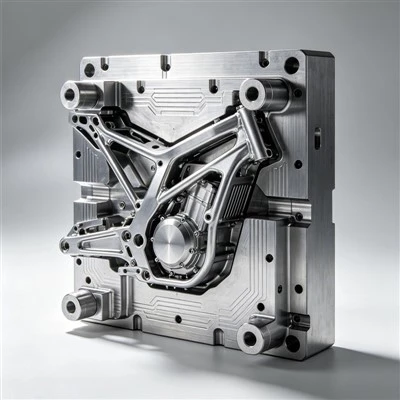
First, let’s get the basics straight: mold sticking (also called “die soldering” if it’s metal bonding, or “deposit buildup” if it’s residual material) happens when hot molten aluminum, zinc, or other alloys latch onto the mold’s surface. For us mold suppliers, we see this most often when clients run molds without matching the mold’s design to their alloy, or skip small maintenance steps that add up fast. I’ve had a customer call me at 2 a.m. because their brake caliper molds were sticking so bad, they had to pull 50 bad parts off the line before their shift started. That’s avoidable, and here’s how.
Start with the mold itself—since I build these, this is stuff I tell every new client before they even pour their first metal. A lot of people cut corners on mold surface preparation, thinking a polished finish is enough. Nah, it’s deeper than that. When I machine a mold’s cavity, I use a diamond-tipped burnishing tool to create a uniform, non-directional surface texture—no sharp tool marks that can catch molten metal. I also add a thin layer of hard chrome plating (or even better, electroless nickel-phosphorus plating) that’s smooth and corrosion-resistant. Wait, why electroless over regular chrome? Because regular chrome has tiny pores where metal can seep in and bond. Electroless is more uniform, so there’s nowhere for the alloy to grab. I’ve seen a mold with electroless plating last 3x longer before sticking becomes an issue than the same mold with standard chrome.
Next, alloy matching is non-negotiable. You can’t use a zinc alloy mold for aluminum, or vice versa, and expect no sticking. For example, aluminum alloys like A380 are super common for industrial parts, but they have high silicon content that loves to stick to steel molds if the mold’s surface isn’t treated for it. For our clients running aluminum, I add a special silicon-resistant coating to the mold’s cavities and cores—nothing fancy, just a physical vapor deposition (PVD) coating that creates a barrier between the alloy and the steel. I had a client who was switching from zinc to aluminum parts, and before they added that coating, they had a 12% scrap rate from sticking. After we adjusted the mold’s coating, that scrap dropped to less than 2%. That’s real numbers, not marketing fluff.
Then there’s the release agent—this is where so many shops mess up. A lot of guys just grab whatever release agent’s cheap, spray a quick coat, and call it a day. But release agents aren’t all the same, and how you apply them matters a ton. For hot chamber die casting (which is what we use for zinc alloys), a water-based graphite release agent works best, but you can’t over-spray it—too much leaves a thick buildup that burns into the mold, and too little leaves gaps where metal sticks. For cold chamber (aluminum, magnesium), an oil-based or polymer-based release agent is better, because it can handle the higher temperatures (up to 1300°F for aluminum). Pro tip from my team: always test the release agent on a small, hidden part of the mold first. I’ve had a client use a release agent that said it was “die casting compatible” but it reacted with our mold’s plating, causing pitting that led to sticking within a week. Test small, not full production.
Wait, also—mold temperature control. This is another big one. If your mold is too cold, the molten metal cools too fast and sticks to the surface. If it’s too hot, the release agent burns off before the part is ejected, and metal bonds. For most aluminum alloys, the mold should stay between 350°F and 450°F, and for zinc, around 250°F to 300°F. We build our molds with integrated cooling lines that are sized specifically for the part’s size—no generic cooling channels that leave hot spots near the gates or cores. I once re-tooled a mold for a client where their cooling lines were just straight holes drilled through; after we redesigned them to wrap around the cavity edges, their sticking issues went away entirely. They didn’t even need to change the release agent after that.
Don’t skip regular mold maintenance, either. A lot of shops only clean their molds when sticking gets bad, but small deposits build up every cycle, and over time those deposits act like a net for molten metal. We recommend a “light clean” every 500 to 1000 cycles, using a glass bead blast (not sand blasting, which can damage the plating) to remove residual metal and release agent buildup. Every 5,000 cycles, do a deep clean with a chemical solution designed for die casting molds—something that dissolves soldered metal without hurting the surface coating. I had a client who skipped light cleans for 3,000 cycles, and their mold had a thick layer of stuck metal that required us to re-plate the whole cavity. That cost them $1,500 and 3 days of downtime—way more than the cost of a weekly light clean.
Oh, and part design matters too—even if you have a perfect mold, a bad part design can lead to sticking. For example, sharp corners or undercuts in the part mean the mold has to hold onto those areas longer, increasing the chance of metal bonding. I always work with clients on part redesign before building a mold—suggesting rounded edges, proper draft angles (1-2 degrees per side, minimum), and even ejector pin placement that targets high-sticking areas. One client was designing a complex gear part with a tiny undercut; when we suggested a draft angle and moved the ejector pins to the thickest section, they cut their sticking-related scrap by 70% right off the bat.
Wait, let’s talk about a common misconception: people think more draft = less sticking, but too much draft can cause part warping, especially for thin industrial parts. It’s a balance. Our mold engineers calculate draft based on the part’s material, thickness, and cycle time—so it’s not guesswork. We also add venting channels to the mold, which let air escape as the metal fills the cavity. If air is trapped, it creates pressure that makes the part stick to the mold. I’ve seen molds with clogged vents cause sticking because the metal can’t flow smoothly around the cavity edges. That’s why we machine vents to be narrow enough (0.001 to 0.003 inches) to let air out but not let the alloy seep in, and we design them to be easy to unclog during maintenance.
Let’s wrap this up with a story that stuck with me (pun intended). A few years back, a client came to me with a new die casting line for aluminum HVAC parts. Their initial setup: a cheap mold from a random supplier, generic release agent, no temperature control. They had a 20% scrap rate from mold sticking—they were ready to scrap the whole line. We rebuilt their mold with the right electroless nickel plating, added custom cooling lines, adjusted the venting, and recommended a polymer-based release agent applied with a 2-second spray per cavity. After a week, their scrap rate dropped to 1%—and they still use that mold today, two years later, with almost no sticking issues. That’s the difference between a mold built with purpose and one that’s just thrown together.

If you’re dealing with mold sticking on your industrial parts, don’t just tinker with release agents and cross your fingers. Most of the time, it’s a combination of mold design, material matching, maintenance, and process tweaks that fixes it for good. As someone who’s built die casting molds for years, I’ve seen the fix, I’ve tested the fixes, and I can help you figure out what’s going wrong with your current setup. If you’re tired of production delays, high scrap, and extra maintenance costs from mold sticking, reach out to chat through your specific mold and part needs. Let’s get your line running smoothly—no more stuck parts, no more lost time, no more headaches.
Aluminum Alloy Die Casting Mold References
- Die Casting Handbook: Materials, Processes, and Practice. American Foundry Society, 2019.
- “Soldering in Die Casting: Causes and Prevention Techniques.” Journal of Die Casting Technology, vol. 14, no. 2, 2021, pp. 45-52.
- Electroless Nickel Plating for Die Cast Molds: Best Practices. Surface Engineering Association, 2020.
- “Mold Temperature Control for Aluminum Die Casting.” Manufacturing Engineering Journal, vol. 126, no. 5, 2022, pp. 78-83.
Hangzhou Pullbull Technology Co., Ltd.
As one of the most professional industrial parts die casting mold manufacturers and suppliers in China, we offer a wide range of products with superior quality. Please feel free to wholesale bulk premium industrial parts die casting mold from our factory. Also, custom service is available.
Address: Rm 805 Gemini Build 1, #1785 JiangHan Rd, BinJiang, Hangzhou, China 310052
E-mail: markdan@menovo.cn
WebSite: https://www.pbmold.com/
