Hey there! As a torsion spring supplier, I often get asked about how to calculate the energy stored in a torsion spring. It’s a pretty important topic, especially if you’re using these springs in your projects or products. So, let’s dive right in and break it down step by step. Torsion Spring
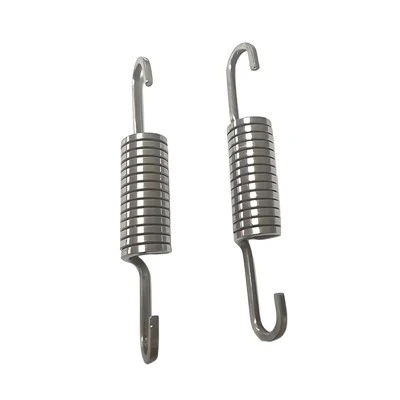
First off, let’s understand what a torsion spring is. A torsion spring is a type of spring that works by twisting. When you apply a torque to it, it stores energy, and when you release that torque, it releases the stored energy, usually by rotating back to its original position. They’re used in a wide range of applications, from small household items like clothespins to heavy – duty industrial machinery.
The Basics of Torsion Spring Mechanics
To calculate the energy stored in a torsion spring, we need to know a few key things. The main parameters involved are the spring rate (k), the angular deflection (θ), and Hooke’s Law for torsion springs.
Hooke’s Law for torsion springs states that the torque (T) applied to a torsion spring is proportional to the angular deflection (θ) from its initial position. Mathematically, it’s expressed as T = kθ, where k is the spring rate. The spring rate is a measure of how stiff the spring is. It tells you how much torque is required to rotate the spring by one unit of angle (usually degrees or radians).
How to Determine the Spring Rate (k)
Calculating the spring rate can be a bit tricky, but I’ll walk you through it. There are two main ways to find the spring rate: experimentally and through calculations.
If you’re doing it experimentally, you can use a simple setup. You attach the torsion spring to a fixed point and apply a known torque using a torque wrench or a calibrated weight system. Measure the angular deflection that occurs due to this torque. Then, use the formula k = T/θ to calculate the spring rate. For example, if you apply a torque of 10 N·m and the spring deflects by 5 radians, the spring rate k = 10 N·m / 5 rad = 2 N·m/rad.
If you want to calculate the spring rate theoretically, you’ll need to know the dimensions of the torsion spring. The formula for the spring rate of a helical torsion spring is (k=\frac{Ed^4}{10.8Dn}), where E is the modulus of elasticity of the spring material, d is the wire diameter, D is the mean coil diameter, and n is the number of active coils.
Let’s say we have a torsion spring made of music wire. The modulus of elasticity E for music wire is around 200 GPa (or (200\times10^{9}) Pa). If the wire diameter d = 0.005 m, the mean coil diameter D = 0.05 m, and the number of active coils n = 10.
First, we substitute these values into the formula:
[
\begin{align*}
k&=\frac{(200\times 10^{9})\times(0.005)^{4}}{10.8\times0.05\times10}\
&=\frac{(200\times 10^{9})\times(6.25\times10^{- 11})}{0.54}\
&=\frac{12.5}{0.54}\
&\approx23.15\ N\cdot m/rad
\end{align*}
]
Calculating the Energy Stored in a Torsion Spring
Now that we know how to find the spring rate, let’s calculate the energy stored. The energy (U) stored in a torsion spring is given by the formula (U=\frac{1}{2}k\theta^{2}). This formula is derived from the work – energy theorem. The work done in rotating the spring through an angle θ is equal to the energy stored in it.
Let’s use the previous example where the spring rate k = 23.15 N·m/rad. Suppose we rotate the spring through an angular deflection θ = 3 radians. Then, the energy stored in the spring is:
[
\begin{align*}
U&=\frac{1}{2}\times23.15\times(3)^{2}\
&=\frac{1}{2}\times23.15\times9\
& = 104.175\ J
\end{align*}
]
Factors Affecting Energy Storage
There are several factors that can affect the energy storage capacity of a torsion spring.
Material: Different materials have different moduli of elasticity. For example, stainless steel has a different E value compared to music wire. A higher modulus of elasticity generally means a stiffer spring, which can store more energy for a given deflection.
Wire diameter: Increasing the wire diameter will increase the spring rate and thus increase the energy – storing capacity. However, it also makes the spring bulkier and heavier.
Coil diameter: A smaller mean coil diameter can increase the spring rate, leading to more energy storage. But it also puts more stress on the spring material.
Number of coils: More active coils usually result in a lower spring rate and less energy stored for a given applied torque. However, they can provide a smoother and more gradual release of energy.
Practical Applications and Why Understanding Energy Storage Matters
In real – world applications, knowing how much energy a torsion spring can store is crucial. For example, in a door hinge application, you want to make sure the torsion spring can store enough energy to close the door properly. If the spring doesn’t store enough energy, the door won’t close all the way. On the other hand, if it stores too much energy, it can be difficult to open the door.
In automotive engines, torsion springs are used in valve trains. The energy stored in these springs needs to be precisely calculated to ensure proper valve operation. If the spring doesn’t have enough stored energy, the valve might not close correctly, leading to engine performance issues.
Our Role as a Torsion Spring Supplier
As a torsion spring supplier, we play a vital role in helping our customers with these calculations. We have a team of experts who can assist you in choosing the right spring for your application. We can help you determine the optimal dimensions, material, and spring rate based on your energy – storage requirements.
Whether you’re working on a small DIY project or a large – scale industrial application, we’ve got you covered. We offer a wide range of torsion springs in different materials, sizes, and specifications. Our springs are made with high – quality materials and precision manufacturing processes to ensure reliable performance and accurate energy storage.
Leaf Spring If you’re in the market for torsion springs and need help with calculating the energy storage or choosing the right spring, don’t hesitate to reach out. We’re here to provide you with the best products and support to meet your needs. Contact us to start a conversation about your torsion spring requirements, and let’s work together to find the perfect solution for your project.
References
- Shigley, J. E., & Mischke, C. R. (2001). Mechanical Engineering Design (6th ed.). McGraw – Hill.
- Budynas, R. G., & Nisbett, J. K. (2011). Shigley’s Mechanical Engineering Design (9th ed.). McGraw – Hill.
Shengzhou Deyuxiang Hardware Accessories Co., Ltd.
We are one of the most professional torsion spring manufacturers and suppliers in China, also support customized service. With abundant experience, we warmly welcome you to buy high quality torsion spring made in China here and get pricelist from our factory. For price consultation, contact us.
Address: No. 38, Caosheng Road, Caoqiao Street, Pinghu City, Jiaxing City, Zhejiang Province
E-mail: 877286126@qq.com
WebSite: https://www.dyx-spring.com/
